“AI will grow” is a useless career prediction.
Everything adjacent to AI will grow. The harder question is where value and scarcity survive after models become dramatically more capable.
That distinction matters because the scale of the transition is no longer in dispute. Workers with AI skills now command a 62% wage premium. AI-skill job postings are growing roughly eight times faster than the overall job market. U.S. private AI investment reached $285.9 billion in 2025, while the four largest hyperscalers plan roughly $700 billion in capital spending for 2026.
But investment does not tell you which career to choose.
I wanted to answer a more personal question: if I were going to spend the next decade becoming exceptional at one layer of AI, which layer would still be valuable in 2036?
Most career lists fail here. They rank whatever is hottest today: prompt engineering, agents, RAG, multimodal models.
That is trend extrapolation, not forecasting.
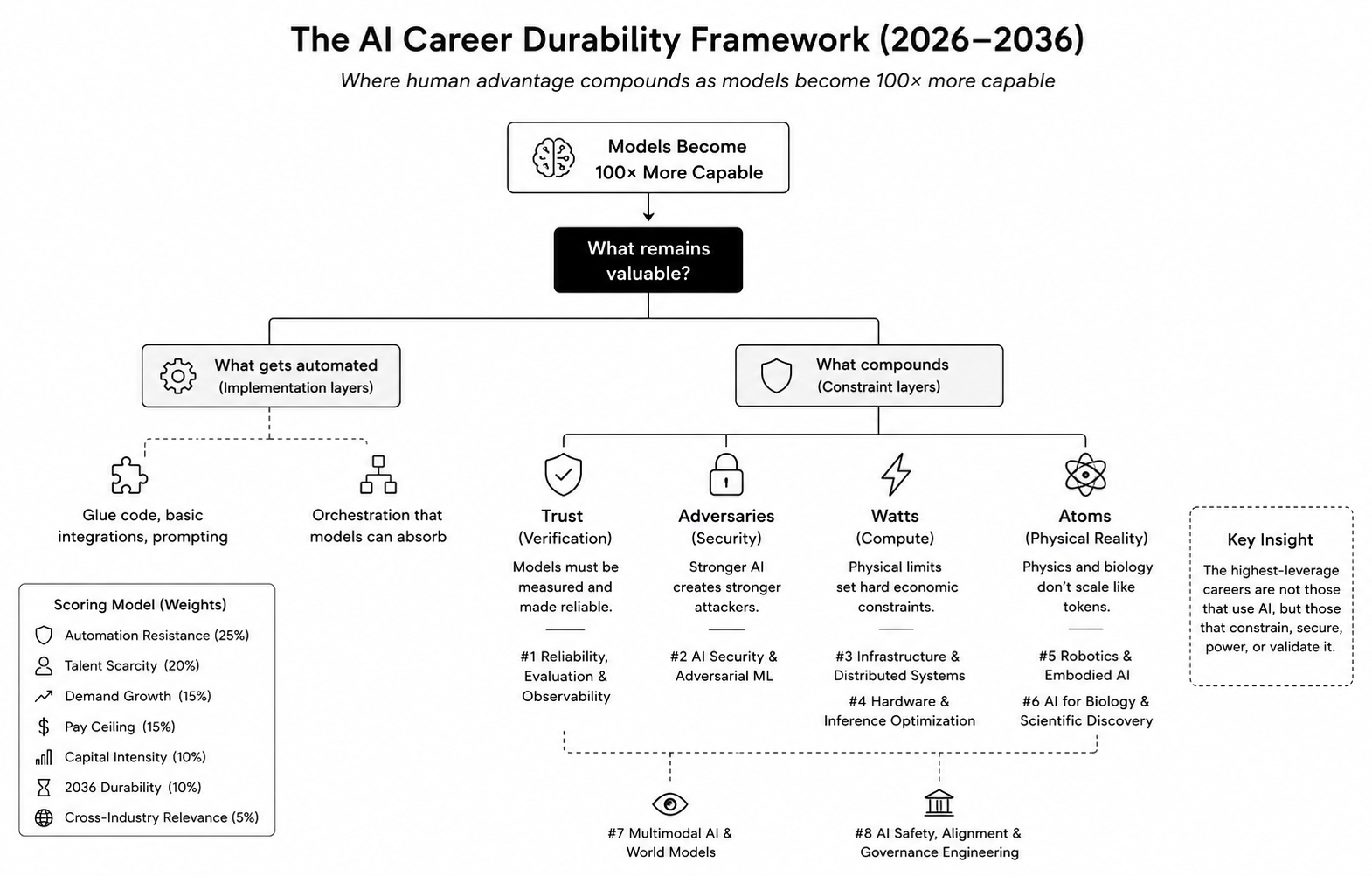
So I scored ten AI fields from 1 to 5 across seven factors:
- Automation resistance: 25%
- Talent scarcity: 20%
- Demand growth: 15%
- Pay ceiling: 15%
- Capital intensity: 10%
- 2036 durability: 10%
- Cross-industry relevance: 5%
The weights are judgment. Disclosing them makes the ranking attackable, which is the point.
The final stress test was simpler:
Does this field remain valuable if AI models become 100× more capable?
Here is the ranking, weakest defensible field first.
10. Vertical AI Systems — 3.05/5
Vertical AI means building AI products inside domain-heavy industries such as healthcare, law, finance, and manufacturing.
This field may create more jobs than almost anything else on the list. Generative AI is already used in at least one business function at 70% of organizations.
But job volume and career scarcity are not the same thing.
The integration layer is also where better models may automate fastest. Connecting models to workflows, documents, and business software is valuable today. Over a decade, much of that work may become infrastructure.
What survives is not the glue code. It is domain judgment.
Representative roles: forward-deployed engineer, domain ML engineer.
The risk: Vertical AI could keep producing enormous numbers of jobs while the scarcity—and therefore the premium—of individual engineers declines.
This is a volume bet, not necessarily a premium bet.
9. AI Agents and Orchestration — 3.40/5
This is the hottest field of 2026—and the scoring model punished it.
Agent engineering means designing systems that coordinate models, tools, memory, permissions, and long-running workflows.
Demand is enormous. Automation resistance is not.
The problem is simple: agent capability is exactly what frontier labs are trying to absorb into the models themselves. Frameworks are converging. Models are getting better at tool use, planning, memory management, and recovery.
The strongest counterargument is important: orchestration could mature into a permanent systems discipline, just as distributed systems did.
Heterogeneous models, permissions, long-running state, human approvals, and organizational complexity may refuse to disappear.
My low ranking assumes models and platforms absorb much of today's orchestration work.
That assumption could be wrong.
Representative roles: agent engineer, AI platform engineer.
The risk: Nobody knows whether orchestration becomes a durable engineering layer or a temporary abstraction that better models consume.
8. AI Safety, Alignment, and Governance Engineering — 3.80/5
This is not ethics paperwork.
The valuable technical layer turns alignment and policy requirements into actual controls: permissions, behavioral constraints, audit systems, model policies, and deployment boundaries.
AI-specific governance roles grew 17% in 2025. The share of businesses with no responsible-AI policies fell from 24% to 11%.
The field scores highly on automation resistance for an obvious reason: it exists to check automated systems.
Representative roles: alignment engineer, AI governance engineer, model policy specialist.
The risk: Some demand depends on regulation. A major political shift toward deregulation could concentrate the best opportunities inside frontier labs and heavily regulated industries.
7. Multimodal AI and World Models — 3.85/5
World-model research sits near the frontier: models that jointly learn video, physics, spatial reasoning, and action.
The pay ceiling is exceptional. So is the scarcity.
The problem is seat count.
Industry now produces more than 90% of notable frontier models, and only a small number of labs can afford to compete at the frontier.
This may be one of the most intellectually valuable fields in AI without becoming one of the largest job markets.
Representative roles: research scientist, world-model engineer, simulation engineer.
The risk: World models may never remain a distinct career category. They could simply dissolve into general foundation-model research.
6. AI for Biology and Scientific Discovery — 4.05/5
Prediction is getting cheaper.
Biological validation is not.
That is the career signal.
Of more than 500 clinical AI studies reviewed in recent research, only 5% used real clinical data. The bottleneck is not merely generating hypotheses. It is proving that they survive contact with biology, patients, laboratories, and regulation.
Better models do not eliminate that constraint.
Representative roles: computational biologist, ML-for-science engineer, clinical AI validation engineer.
The risk: The science may be transformative while the job market remains relatively small. Long regulatory and experimental cycles can delay economic payoff for years.
5. Robotics and Embodied AI — 4.30/5
Software scales cheaply.
Atoms do not.
Robotics becomes economically important when models can generalize across physical tasks. But real-world deployment remains constrained by hardware cost, safety, data collection, controls, and reliability.
Those constraints create engineering demand even as foundation models improve.
A model can generate a million lines of code at almost zero marginal cost. A robot still has to survive gravity, friction, hardware failure, and humans.
Representative roles: robot-learning engineer, controls engineer, teleoperation and data-operations engineer.
The risk: Hardware cost curves may improve too slowly. The technology could remain impressive while broad commercial deployment takes longer than expected.
4. AI Hardware and Inference Optimization — 4.40/5
AI eventually runs into physics.
Power. Memory. Bandwidth. Heat. Silicon.
AI data-center power capacity has reached 29.6 gigawatts. Microsoft attributed $25 billion of its 2026 capital spending to rising memory and component costs alone.
When compute and energy become binding constraints on a trillion-dollar buildout, an engineer who cuts inference cost by 30% creates directly measurable economic value.
That is why the pay ceiling is so high.
Representative roles: kernel engineer, ML compiler engineer, inference-platform engineer, silicon architect.
The risk: The seat count is small, and a major hardware discontinuity could reset parts of the optimization stack.
This is a high-pay, low-volume career bet.
3. AI Infrastructure and Distributed Systems — 4.50/5
Every AI product eventually depends on infrastructure someone has to make fast, cheap, available, and reliable.
The largest hyperscalers plan roughly $700 billion in 2026 capital spending. Microsoft expects to remain capacity-constrained through at least 2026.
But the strongest reason to bet on this field is not spending.
It is experience.
Distributed-systems failure modes are learned in production over years. They live in networks, clusters, schedulers, storage systems, latency tails, hardware failures, and the ugly interactions between them.
Better code generation does not instantly create that judgment.
Representative roles: distributed-training engineer, GPU-cluster engineer, AI infrastructure engineer, SRE.
The risk: A major AI-capex correction could slow hiring.
It would not eliminate the underlying systems problem.
2. AI Security and Adversarial ML — 4.50/5
Every deployed AI agent is a new attack surface.
It may have access to credentials, databases, browsers, code execution, company documents, and money.
Cybersecurity engineers are already among the hardest technical roles to hire.
The structural reason this field ranks second is stronger than any single hiring statistic:
Better AI helps attackers too.
Security is adversarial. Every improvement in model capability can create new offensive capabilities, new vulnerabilities, and new systems worth attacking.
Demand therefore scales with AI capability rather than simply being automated away by it.
Representative roles: AI red-teamer, ML security researcher, agent-security engineer.
The risk: AI will automate routine defensive work.
But routine work was never where the highest pay ceiling existed.
1. AI Reliability, Evaluation, and Observability — 4.65/5
The most valuable question in AI may become:
How do you know the system actually works?
Reliability engineering measures AI systems in production through evaluations, monitoring, failure analysis, tracing, and guarantees.
The evidence for the problem is already visible.
Documented AI incidents rose to 362 in 2025, a 55% increase. One recent accuracy benchmark found hallucination rates across 26 leading models ranging from 22% to 94%. Reporting on responsible-AI benchmarks remains sparse.
The causes of failed AI systems are plural: bad data, unclear ROI, weak workflow design, security problems, and unreliable model behavior.
Reliability is not the sole solution.
It ranks first because measurement is upstream of most solutions.
You cannot prove ROI without evaluation.
You cannot certify a workflow without testing it.
You cannot bound risk without measuring failure.
You cannot improve a system if you cannot explain why it failed.
Every capability gain increases the gap between what models can do and what organizations can confidently verify.
Representative roles: evaluation engineer, AI observability engineer, reliability engineer for autonomous systems.
The risk: Two things could break this prediction.
Frontier labs could make verification a native model capability.
Or reliability could become part of every engineer's job instead of remaining a distinct, highly paid discipline.
Both are real possibilities.
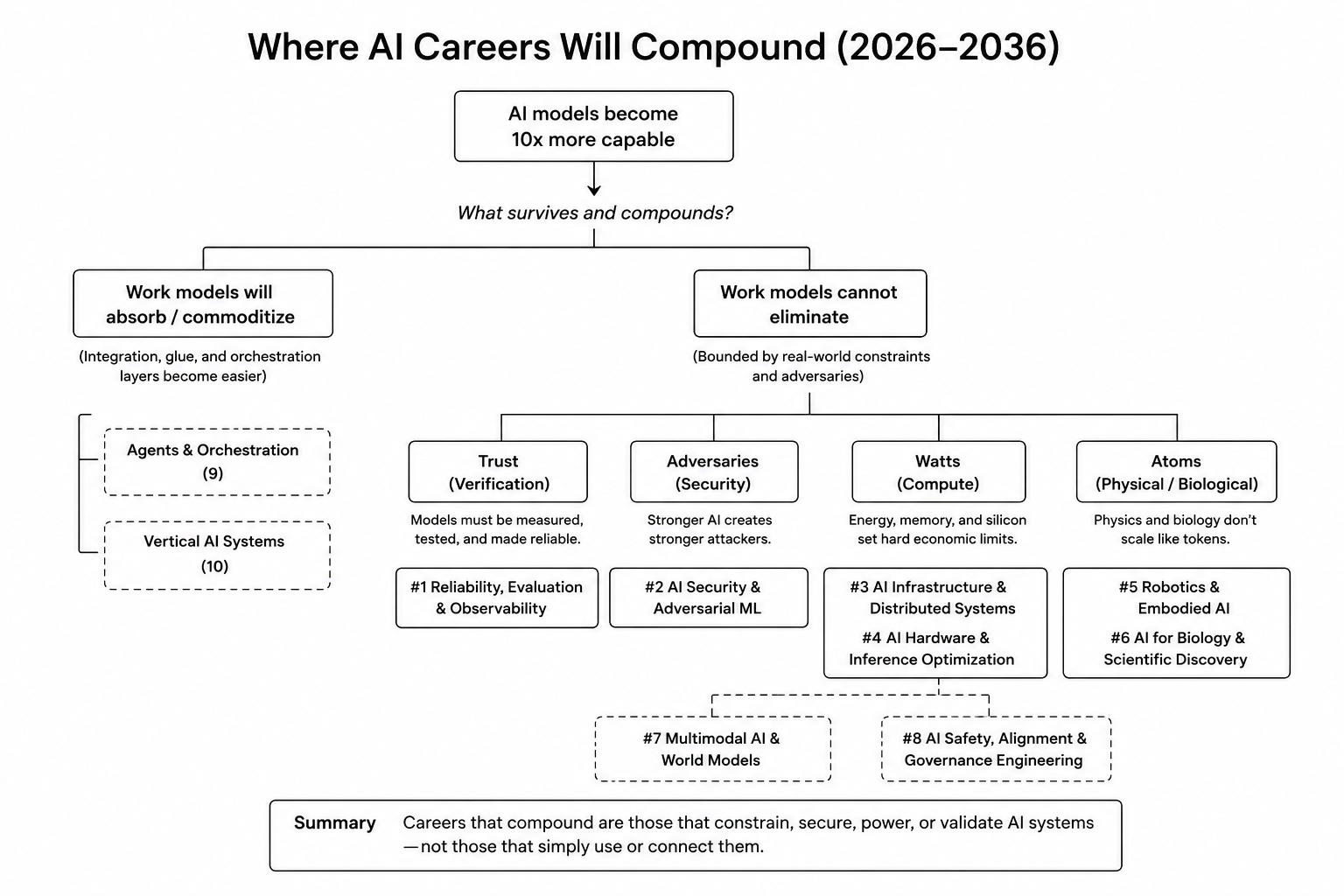
The Pattern Behind the Ranking
The ranking produced a cleaner conclusion than I expected.
Work that uses models is commoditizing:
- prompting
- basic integrations
- orchestration glue
Work that constrains models is appreciating:
- proving them reliable
- securing them against adversaries
- powering them efficiently
- embedding them in physics
- validating them against biology
Each capability gain enlarges the verification, attack, energy, or physical surface around the model.
There are also two very different career bets hidden inside the ranking.
Some fields have high pay but few seats: hardware, world models, AI for science.
Others have many seats but weaker scarcity: vertical AI and agent engineering.
The best career is not automatically the field with the highest score. It depends on whether you are optimizing for job volume, exceptional compensation, research depth, startup opportunity, or geographic mobility.
But the structural pattern remains.
The strongest engineers of the next decade will work where model capability meets a constraint it cannot cheaply wish away:
Trust. Adversaries. Watts. Atoms.
This ranking fails badly in one world: models that can reliably verify, secure, and physically deploy themselves.
Short of that, the career strategy is simple:
Don't build what the model will absorb. Build what the model must answer to.
The Scoring Model
The scores are structured expert judgment, not objective truth.
A score of:
- 5 means overwhelming evidence or structural necessity.
- 4 means strong evidence with meaningful uncertainty.
- 3 means credible growth but limited scope or unresolved durability.
- 2 means weak defensibility or high automation exposure.
- 1 means declining strategic value or extreme automation risk.
The final ranking used these weights:
Automation resistance: 25% · Talent scarcity: 20% · Demand growth: 15% · Pay ceiling: 15% · Capital intensity: 10% · 2036 durability: 10% · Cross-industry relevance: 5%
The final weighted scores:
1. AI Reliability, Evaluation & Observability — 4.65
2. AI Security & Adversarial ML — 4.50
3. AI Infrastructure & Distributed Systems — 4.50
4. AI Hardware & Inference Optimization — 4.40
5. Robotics & Embodied AI — 4.30
6. AI for Biology & Scientific Discovery — 4.05
7. Multimodal AI & World Models — 3.85
8. AI Safety, Alignment & Governance Engineering — 3.80
9. AI Agents & Orchestration — 3.40
10. Vertical AI Systems — 3.05
The model changed my original ranking.
Agents and orchestration fell. AI for biology rose.
That matters because a scoring model is only useful if it can change the conclusion rather than decorate a conclusion chosen in advance.
Sources and Methodology
1. PwC — 2026 Global AI Jobs Barometer
Used for the 62% AI-skills wage premium and the comparison between AI-skilled job growth and the overall job market.
2. Stanford HAI — The 2026 AI Index Report
Used for U.S. private AI investment, the industry share of notable frontier models, robotics data, and broader AI-development trends.
3. Hyperscaler 2026 capital-spending guidance
Used for the combined capital-spending estimates of Amazon, Alphabet, Meta, and Microsoft.
4. Stanford HAI — AI Index 2026, Economy chapter
Used for organizational generative-AI adoption.
5. Stanford HAI — AI Index 2026, Responsible AI chapter
Used for AI incident growth, hallucination benchmarks, governance-role growth, and responsible-AI reporting.
6. Stanford HAI — Inside the AI Index: 12 Takeaways from the 2026 Report
Used for AI data-center power capacity and the clinical-AI validation gap.
7. Microsoft 2026 capital-spending guidance and executive commentary
Used for memory and component-cost pressure and reported capacity constraints.
8. 2026 technology hiring research
Used for evidence on the scarcity of AI and cybersecurity engineers.
Methodology
Each field was scored from 1 to 5 across seven criteria and weighted as described above.
The scores use observed 2026 evidence where available, structural inference where long-term data cannot exist, and explicit uncertainty where the forecast depends on unresolved assumptions.
Every field was stress-tested against the same question:
Does this career remain valuable if models become 100× more capable?
A ten-year forecast cannot be proven in 2026.
The goal is not certainty.
The goal is to make the assumptions visible enough that the ranking can be challenged—and updated when the evidence changes.